The morning carriage was filled with its usual quiet hum — the steady clatter of the wheels, the faint hiss of brakes, a few murmured conversations, and the comforting scent of coffee from travel mugs. Passengers sat lost in their screens, half-awake, half-dreaming on their way to work.
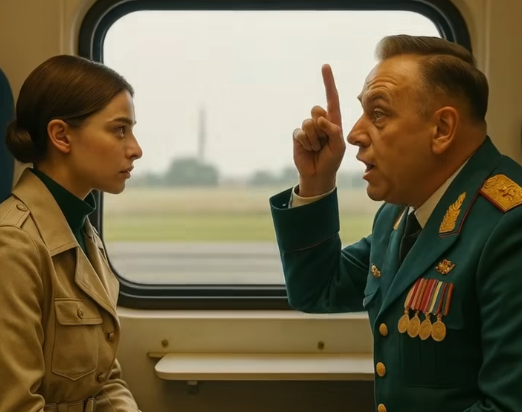
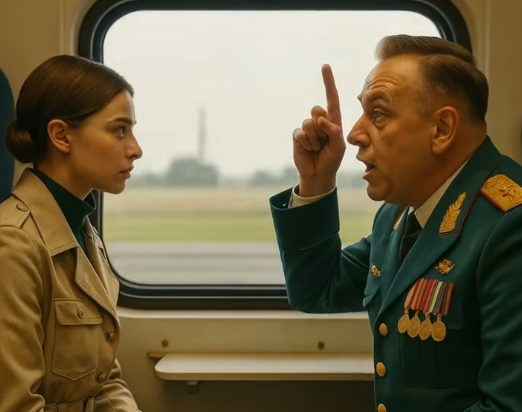
At one of the stops, a young woman boarded — petite, graceful, with her hair tied neatly in a bun and a calm, thoughtful look. She wore a beige belted coat, buttoned all the way up to the collar. She took a seat across from a man in a crisp military uniform, his chest heavy with medals — a lieutenant colonel, proud and self-assured, the kind of man used to giving orders and being obeyed.
He glanced at her and frowned. Something about the way the coat sat on her shoulders caught his eye — a glimpse of a dark green collar, like part of a uniform hidden underneath. Irritation flickered in his expression. Perhaps it was pride, or simple boredom, but it made him do something he’d soon regret.
“What’s under your coat?” he asked abruptly, leaning forward.
The young woman looked at him, startled but silent.
“I’m talking to you,” he said, louder now. “Where did you get that uniform? What’s the idea here — playing soldier? Or did you buy it online for a few likes?”
Several passengers turned to watch. The tension was rising.
“I’m sorry,” the young woman said evenly, “but I didn’t give you permission to speak to me that way.”
He scoffed. “Didn’t give me permission? I’ve served in the army for twenty years, young lady! I won’t tolerate someone disrespecting the uniform! It’s sacred! Take it off right now!”
His voice was sharp, echoing through the carriage. Conversations stopped. The woman didn’t move. She met his glare, calm and unflinching.
“Are you finished?” she asked softly.
The colonel opened his mouth to reply — but froze as she slowly unfastened the belt of her coat and slipped it off her shoulders.
Underneath was a flawless military uniform, neatly pressed, with the insignia of the Special Forces gleaming on her sleeve. On her chest shone a row of medals — and on her collar, the insignia of a Major.
She took out her identification, placed it in front of him, and said clearly:
“Major, Special Forces. I appreciate your concern for the honor of the army. Although, it’s interesting that you defend it by shouting at a fellow officer in public.”
The carriage fell completely silent. The lieutenant colonel’s face turned crimson, then pale. His lips trembled. He wanted to speak, but the words wouldn’t come.
“Perhaps command would like to know how you ‘defend honor’ — or maybe you’d prefer to apologize?”
He swallowed hard, leaned back, and muttered quietly:
“I’m sorry, Major… I… I didn’t know.”
She nodded once, not meeting his eyes.
“Sometimes,” she said quietly, “it’s best to know who you’re talking to before you raise your voice.”
With that, she stood, adjusted her cap, and stepped off the train at the next stop, leaving behind a heavy silence.
The passengers sat motionless, their eyes drifting toward the lieutenant colonel — who stared at the floor, his medals suddenly feeling heavier than ever.