The Wid0w’s Flame: During His Wife’s Cremation, a Husband Saw Her Belly M0ve — and Discovered the Sin That Had Been Bu’rning in His Family for Generations…
The sound of fire was supposed to be final. For Julian Keats, it was meant to mark the end — of grief, of chaos, of the unbearable silence that had filled his house since Elara died. But as he stood before the furnace, staring at her pale body wrapped in silk, the flicker of the flames reflected not peace, but something restless. And when her stomach moved — just once, barely perceptible — something inside Julian’s mind snapped like glass.
It was impossible. It was madness. But it happened. And from that moment on, nothing in the Keats household — or in Julian’s own mind — would ever be the same.
Elara hadn’t belonged to his world.
He was the heir to a family that built hospitals, schools, and eventually, an empire of private clinics. She was a literature teacher from a coastal town, a woman whose life was measured not by wealth but by small kindnesses: watering her neighbor’s flowers, lending her students books she couldn’t afford to replace. Julian had fallen for her the moment she laughed at one of his nervous jokes, back when his name still meant nothing to her.
Their love had been quiet, built in the spaces between obligations — her late-night grading sessions, his endless board meetings. For a time, they’d made it work. But his mother, Evelyn Keats, had never approved.
“She doesn’t understand what we are,” Evelyn had said, her eyes as cold as the marble floors she walked on. “She’s not like us.”
It wasn’t about class, not really. It was about control. Evelyn controlled everything: the estate, the family trust, the perception of perfection she’d curated for decades. And Elara — soft-spoken, honest, unpretentious Elara — threatened all of it.
Julian had thought love would be enough to keep them safe. He was wrong.
When Elara became pregnant, Evelyn’s façade of civility began to crack. The visits became frequent, her tone brittle, her questions invasive. She wanted tests, doctors, “family-approved care.” Elara resisted, gently at first, then with fear beneath her politeness.
One morning, Evelyn brought tea. “It’s an old family blend,” she said, smiling tightly. “It will help with the morning sickness.”
Elara hesitated. “I’m fine, really—”
But Evelyn pressed the cup into her hands. “Drink, darling. Trust me.”
Julian found her collapsed on the stairs three hours later.
The hospital said it was cardiac failure. No signs of trauma. No evidence of foul play. Just… sudden death.
The baby — a girl, according to the ultrasound Elara had hidden in her nightstand — was lost with her.
Julian stopped sleeping after that. Stopped eating. He became a ghost haunting his own home. Evelyn took charge of everything, from the death certificate to the cremation. “It’s what’s best,” she said. “Let her go.”
But Elara had always said she was afraid of fire.

When Julian protested, Evelyn’s voice cut through the air like a blade. “She was an outsider, Julian. She doesn’t get to dictate tradition. This family burns its dead — we always have.”
And so, on a gray afternoon soaked with mist, they gathered in the old Keats crematorium, a relic of the family’s past tucked behind the chapel on their ancestral grounds.
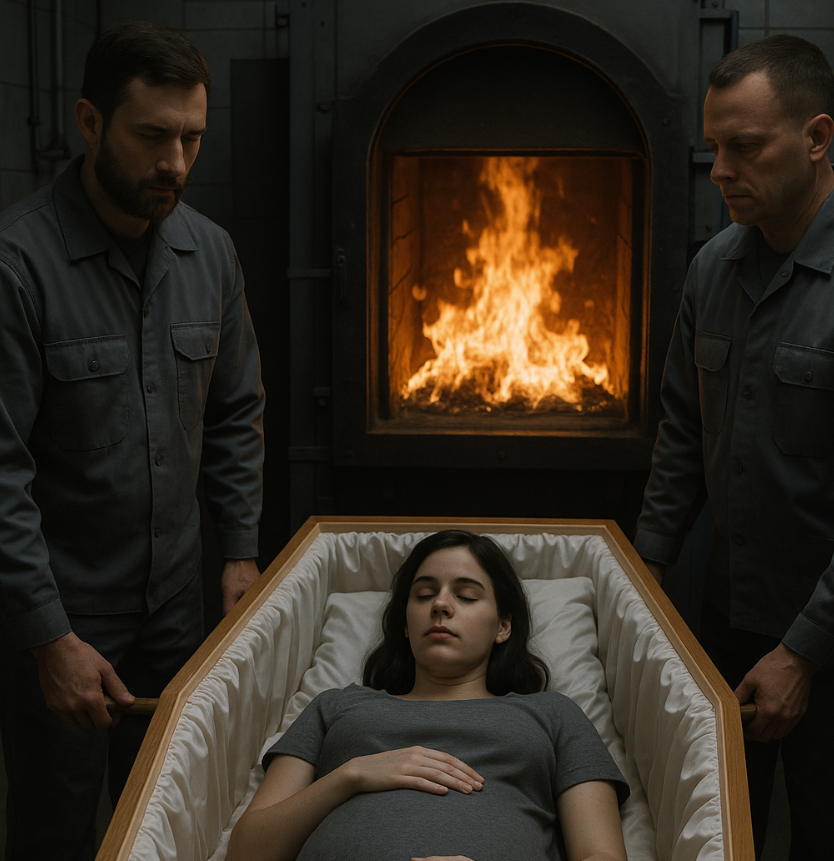
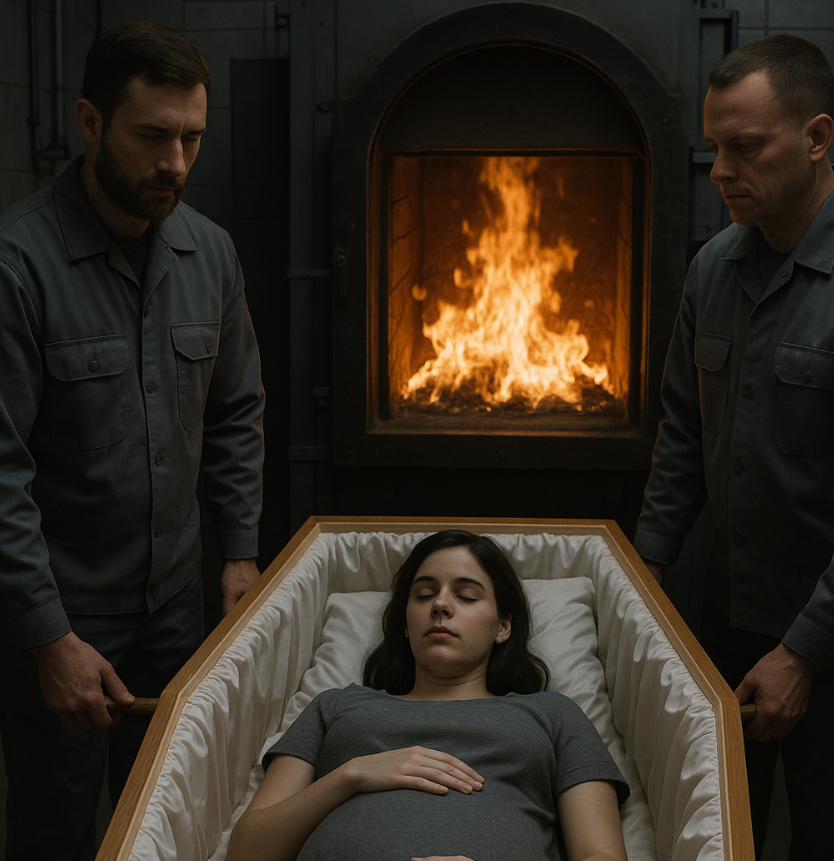
Julian stood over Elara’s still form, the silk shroud soft and luminous under the dim light. The baby bump — barely showing — made her look like she was only sleeping. He touched her hand. Still warm.
Evelyn’s voice broke through the silence. “Say goodbye, my son.”
The priest began the prayer, the attendants adjusted the machinery, and Julian’s vision tunneled. The sound of the furnace igniting roared in his chest like a second heartbeat. He leaned forward, whispering to her, “I’m sorry. I should have protected you.”
That was when he saw it.
The silk over her belly shifted.
At first, he thought it was air, or heat, or his grief manifesting tricks in his vision. But then — unmistakably — it moved again, a subtle, pulsing motion, as though something inside her had tried to stretch.
His breath hitched. “Stop!” he shouted. “Wait, she moved! She’s—she’s alive!”
The priest froze. The attendants exchanged uncertain looks.
But Evelyn stepped forward, her face unreadable. “It’s only gas, Julian,” she said evenly. “Muscle spasms. They happen. She’s gone.”
“No—please—”
“Let her go,” she whispered. And with that, she gave a single nod.
The furnace door closed.
And the sound of fire swallowed the world.
That night, Julian woke screaming. He had dreamed of Elara’s face — not peaceful, but twisted in terror, her hands pressed against glass, her lips mouthing words he couldn’t hear. He woke drenched in sweat, the smell of smoke clinging to his skin. He stumbled to the bathroom, splashing water on his face, and when he looked in the mirror — for a split second — he thought he saw her reflection behind him.
The next morning, he went to the crematorium again. Evelyn forbade it, but he didn’t care. The urn was still warm when he touched it. He sat there for hours, whispering apologies to the ashes.
That was when he noticed it: a faint smell, not just of ash, but of herbs — bitter, earthy, sharp. He knew that scent. It was the same one Evelyn’s tea had always carried.
He began to dig.
Elara’s medical report had been clean — too clean. When he asked for a toxicology review, the hospital refused, citing “family privacy.” When he contacted her doctor directly, she hesitated. “Mr. Keats,” she said quietly, “there were… anomalies. Trace compounds in her blood. But your mother asked us to destroy the samples. I’m sorry.”
Julian’s world tilted. “What compounds?”
“Digitalis,” the doctor said softly. “Highly toxic in concentrated doses. We use it for certain heart conditions. But it can stop the heart completely if administered improperly.”
It wasn’t a heart failure. It was murder.
And his mother had made sure no one would ever find out.
For days, Julian drifted between fury and madness. He began to hear things in the night — soft humming, like Elara’s lullabies echoing through the walls. He found footprints near the nursery door, faint and ash-gray. And once, just once, he swore he heard a heartbeat. Not his. Not human.
He stopped answering calls. The servants left, frightened by the whispers that filled the house. Evelyn continued to visit, always calm, always poised. “You need rest,” she told him. “You’re becoming paranoid.”
“I saw her move,” he whispered.
Her eyes hardened. “You saw what you wanted to see. Grief plays cruel tricks.”
“Then why do I smell her perfume every night?”
Evelyn’s expression shifted — something flickered behind her composure. “Because guilt doesn’t wash off, my son.”
That night, Julian found her in the study, pouring the same dark tea she’d given Elara.
“Old family remedy,” she murmured, not looking up.
He realized then — she’d been using it for years. On his father. On everyone who had dared to cross her.
“Why?” he asked.
She smiled faintly. “Because purity must be protected. This family’s bloodline must remain untainted. You brought disease into this house when you brought her here.”
His hands trembled. “She was carrying your grandchild.”
“She was carrying ruin,” Evelyn whispered. “And now, so are you.”
Two nights later, Evelyn was dead.
The coroner called it a heart attack. Julian didn’t correct them.
But in the darkness of the crematorium, as the furnace roared again, he stood where his mother’s body lay and whispered, “I wonder if you’ll move too.”
The attendants said he laughed when the flames rose.
Months passed.
The Keats estate fell silent, then empty. Rumors spread in town — that Julian had gone mad, that he’d vanished abroad, that the curse of his bloodline had finally consumed him. No one went near the old chapel anymore. Children swore they saw lights flickering inside at night, and sometimes — faint crying.
Then, nearly a year later, a groundskeeper cleaning the property discovered something buried beneath the ash pit.
A small wooden box, perfectly sealed. Inside was a lock of hair, pale gold and brittle — and beneath it, a note written in a shaky, desperate hand:
“She moved because she lived. You burned her alive.”
The handwriting was unmistakably Elara’s.
But the date — was written three days after her cremation.
To this day, the Keats estate remains unsold. Visitors claim to hear whispers from the crematorium, soft and rhythmic, like a lullaby beneath the crackle of unseen flames. Others swear that, if you look through the furnace glass at midnight, you’ll see a woman’s reflection standing beside you — her belly rising and falling gently, as though something within her still waits to be born. And those who dare to linger long enough to listen always leave trembling, repeating the same words Julian was last heard saying before he vanished:
“Fire doesn’t end everything. Sometimes, it gives life to what should have died.”
“The ashes never cooled. And neither did the truth.”