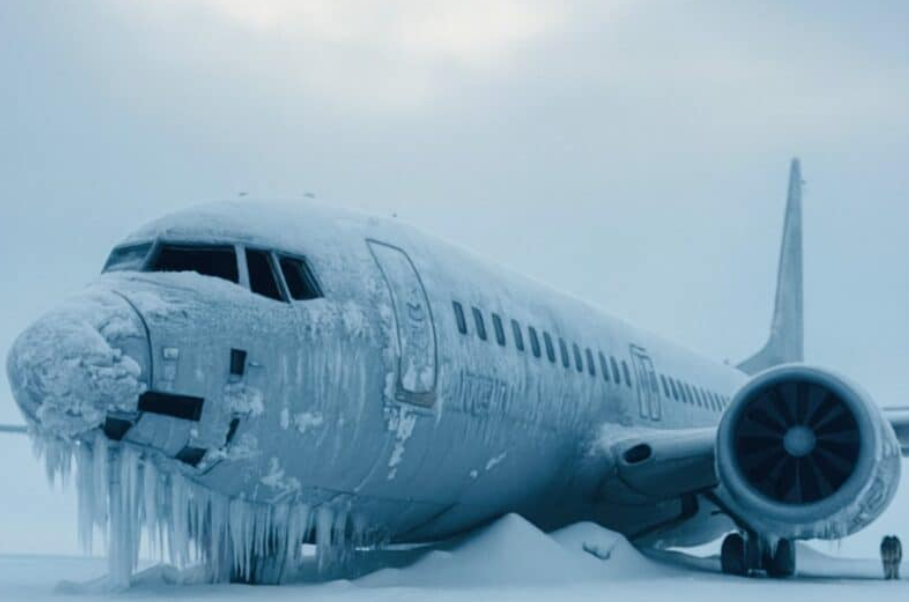
Scientists discovered a huge airplane inside the ice in the middle of the forest, and what they found inside shocked everyone. The expedition set out for the remote northern regions after satellites detected a strange anomaly: beneath a meter-thick layer of snow and ice, smooth, straight lines were visible — lines that looked too much like the outline of a metal fuselage.
The team expected to find a fallen satellite or an old cargo plane from the mid-20th century, but not what appeared before them.
The airplane stood in the middle of an endless white desert, as if someone had carefully landed it on the ice and instantly frozen it in a single moment of time. Ice stalactites hung from the wings, the windows were covered with frost, and wolves circled around the aircraft.
When the scientists came closer, their attention was drawn to the wolves — they stood in front of the entrance to the airplane, as if waiting for someone or trying to warn them. The animals didn’t attack, but their gaze was anxious, as if they understood that humans shouldn’t go inside.
Several researchers carefully climbed up the ice-covered stairs and opened the door, tearing it away from the frozen frame with difficulty. What they saw in the cabin made some of them recoil.
Continuation in the first comment
They heard a howl from the tail section of the airplane, so the scientists decided to check whether animals had gotten trapped inside the fuselage. Beneath the snow they found a small hollow.
Carefully clearing the way, they saw a narrow passage leading under the fuselage. There, in an improvised icy shelter, a real wolf pack was hiding. But that wasn’t what drew the researchers’ attention.
Under the animals they found remains of fabric — scraps of clothing. Not human clothing. It was a dense thermal material, the same kind used in rescue kits of old airliners.
And just a bit farther, deeper inside, lay a metal box. The box was old, rusty, but intact — the kind that is normally installed under passenger seats in case of an emergency landing.
But inside they didn’t find standard rations or medical kits. They found a folder with documents, sealed back in the 1980s.
The documents turned out to be technical reports about an experimental navigation system that the crew of that very airplane had been testing.
According to the papers, the airliner was performing a classified government test flight connected to new methods of autonomous navigation in conditions of polar magnetic disturbances.
The system malfunctioned, and the plane deviated from its course by more than a thousand kilometers, lost contact, and most likely was forced to make an emergency landing on the ice.
But the most important point followed next in the reports: a rescue operation was never launched, because the project was classified and terminated after the accident. The flight was declared unsuccessful, and the data — destroyed.
It turned out that the crew likely survived the landing, managed to get out, took everything they could, and tried to walk to the nearest research station.
But the chance of covering such distances through snow was nearly zero.
The documents confirmed the most likely scenario — the people died somewhere along the way, and the plane remained frozen in the ice.
When the expedition returned, the report caused a huge public reaction. Aviation historians, engineers, and relatives of the missing crew finally received answers.