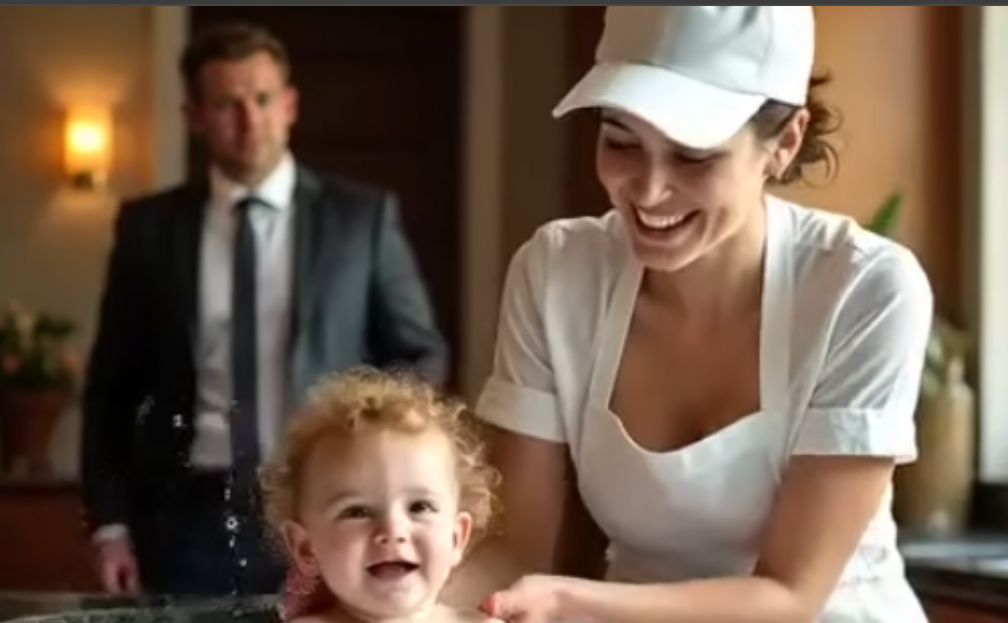
Leonard stopped in the doorway. The sound of his steps faded on the cold tiles, and the air in the kitchen remained suspended. On the counter next to the sink, the steam rose lazily, mixing with the smell of soap. Clara did not turn immediately. She felt his gaze, but stayed there, with the child in her arms, focused on wiping his skin with a gentle motion.
— What are you doing? his voice was calm but sharp.
Clara blinked briefly and turned. Her expression was clear, but without fear. She was holding the towel wrapped tightly around the baby, like a shield.
— I’m washing him, she said simply. He had a bit of a fever, he was sweating.
— In the sink?
— It’s warmer here. He calms down when he feels the water running.
No quiver in her voice. No apology. Just an explanation, spoken naturally.
Leonard remained still. He looked at her hands — thin but steady — at the way she held Sion close, without hesitation. The child squirmed, made a little sound, and hid his face in the woman’s neck.
The man cleared his throat, as if wanting to say something, but he didn’t find the right words. Instead, he took a step forward. The sink was still full of warm water, in which a few small toys were floating. The steam brushed his face.
— Where is Rosland?
— She went out to buy medicine, she said. She told me she’d be quick, but he had been crying for an hour… I couldn’t leave him like that.
Her tone wasn’t apologetic. It was a statement. A fact.
Leonard remained silent. He looked toward the window, where the light filtered through the curtain and gently touched the woman’s temple. He felt something strange — not anger, but a kind of discomfort mixed with respect.
Clara placed the child in the crib in the corner of the room, without looking at him again. She arranged the towel, whispered something to him, then stood up. Her uniform clung slightly to her back, and her hair, tied in a careless bun, had a loose strand on her forehead.
Leonard took a deep breath.
— Next time… let me know.
— Of course, she said.
Their eyes met for just a moment. In hers there was no shame, no defiance. Only a calm tiredness, like those who know what they’re doing and don’t seek approval.
He turned to leave, but stopped again. Behind him, a soft humming was heard — a short melody, almost a murmur.
He recognized it without wanting to. The lullaby his wife used to hum at night, when the baby had just been born.
He remained there, hand on the doorframe. He didn’t turn. He only said softly, almost imperceptibly:
— Thank you.
Clara didn’t answer. She just continued humming, as if no one else was there.
Leonard left the kitchen without a sound, but his steps no longer carried the same certainty as before.
The office smelled of paper burned by the lamp and cold coffee. Leonard had been working for hours, leaning on files, his tie loosened. When he reached for a folder, the cup wobbled and a drop of coffee fell onto his cuff. His reflex was quick — he rubbed the fabric with a handkerchief, but the stain remained, brown and clear. He clenched his jaw, irritated. He pulled the jacket over the stain and closed the laptop with a quick motion.
He left the office, feeling the need for air. The hallway was empty, lit only by a thin strip of yellow light coming from the kitchen. His steps made the same dry sound on the tiles — the only noise in a house too big.
When he entered, Clara was there. The soft light outlined her shoulders and neck, and her loosely tied hair left a few strands on her temples.
The kitchen was quiet, lit only by a small lamp hanging above the counter. Clara stood with her back to the door, wearing soft house slippers. She had worn her uniform all day, but now she had only a thin cotton blouse and a pair of linen pants, slightly too big for her.
She poured hot water into a simple white mug, and the steam rose slowly, cutting her profile in the light. The spoon hit the edges of the mug with a soft sound. She let the tea bag sink slowly, then slightly bowed her head, inhaling the steam.
She seemed in a world of her own. Not rushing. Not hiding.
She leaned her hip against the counter, holding the mug with both hands. She closed her eyes for a moment, as if tasting the quiet. A strand fell over her cheek; without thinking, she blew gently toward it.
Leonard stood in the doorway, invisible. He watched how she moved — attentive, natural, without artificial gestures. There was nothing theatrical in her. Everything seemed natural, yet full of a femininity he had not seen in a long time.
He took a step forward. The floor made a slight creak. Clara turned, surprised, the mug in her hands.
— I’m sorry, I didn’t hear you.
— You don’t have to be, he said, too quickly.
His voice betrayed a vibration he didn’t recognize in himself.
She smiled a little, shyly, but didn’t rush away. She put the mug down, and at that moment noticed the stain on his cuff.
Clara reached out without waiting for permission, took a damp cloth from the counter, and touched his arm. The gesture was natural but improper. She wiped with small, precise movements, without lifting her gaze.
For the first time, Leonard remained completely still. The smell of detergent, the closeness of her skin, the cold touch of the water — all caught him unprepared.
He didn’t say anything. He watched her as she continued, focused on the cuff, without intention, without flirtation.
Just a woman cleaning a stain.
But something in the air changed.
When she raised her eyes, her gaze met his face for a second. They were clear, calm, almost gentle. Behind them there was no fear, no desire, but a kind of quiet courage.
He felt a short wave in his chest, like a tremor. His instinct would have been to stop her — to say “no need” — but his voice got stuck.
He felt vulnerable, caught in a closeness he hadn’t experienced since his wife’s death.
She finished, set the cloth on the counter.
— Done. It’s no longer visible.
She stepped back, without looking at him again.
He stayed there, with his hand on the table, still feeling the cold touch.
— Thank you, he finally said, almost in a whisper.
Clara nodded briefly and stepped away.
Only the soft door sound was heard as it closed.
Leonard remained in the kitchen, alone, with his arm slightly tense. He looked at the stain — completely gone — and understood that that quiet wasn’t quiet at all, but something dangerously close to longing.
After she left, Leonard remained leaning against the counter, with his hand still on the place where he had felt her touch. The kitchen seemed warmer than ever, and the smell of tea floated in the air like a memory. He didn’t understand why her image — the light on her cheek, the simple gesture, the natural look — remained glued to his mind.
He fell asleep late, with the feeling that something had changed, without knowing exactly what.
The next day, in the morning, the sun was descending round over the garden. Rosland was preparing the basket for a picnic: fruits, a big blanket, the baby’s bottles. Leonard, in an unusually calm mood, arrived with little Sion in his arms. He smiled rarely, but now he was smiling.
Clara crossed the yard, carrying the wet clothes to the clothesline. When she saw him, she stopped briefly.
— Are you going somewhere?
— Yes, just a bit outside the city. Rosland insisted.
She nodded, almost embarrassed for asking.
Leonard looked at her for a moment, with the hesitation of a man who feels he’s saying something more important than it seems:
— Maybe you should come too. The fresh air will be good for you. And Sion likes it when he sees you.
She blinked, surprised, then nodded.
— If it doesn’t bother you…
— If it bothered us, I wouldn’t have said it, he replied calmly.
Rosland smiled at her in passing, with a kind of silent understanding.
Later, on the road, in the car, Clara sat in the back seat next to the child, and the morning light drew a thin line on her cheek. Leonard, at the wheel, watched her through the mirror. It wasn’t love yet. It was just quiet. A quiet that felt like the beginning of a new life.
In that moment, he realized he had accepted something he had instinctively rejected until then — the idea that there could be a story for him again. Not like before, not with passion, but with peace. With small gestures, steaming teas, and people who enter your life without knocking.
And for the first time in a long while, Leonard felt that the future was no longer empty.
If you liked it, leave a message for part two and thank you for your attention.